

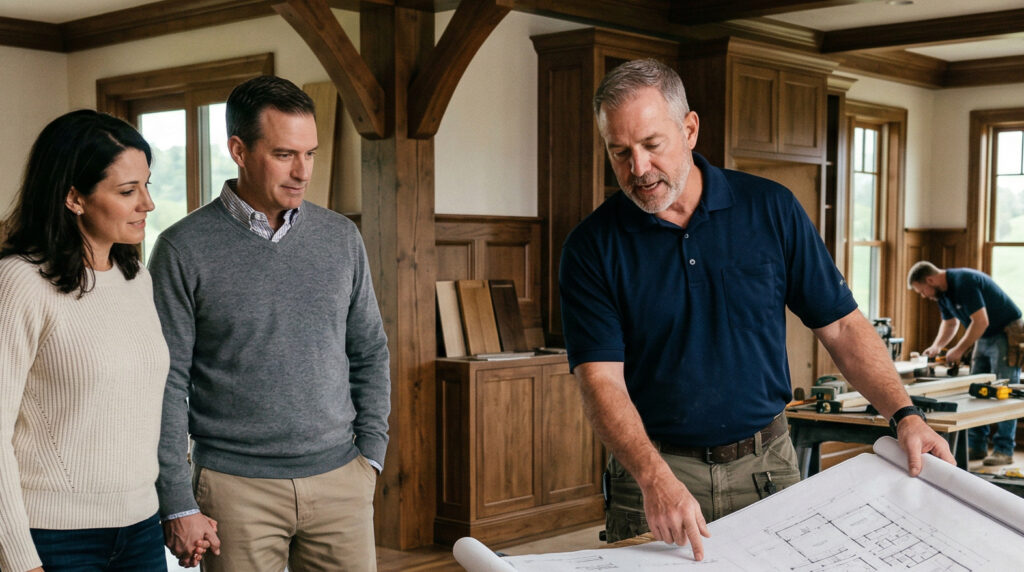
 “I just want one contractor who can manage everything without me chasing people.”
It’s a sentence heard often among homeowners in Loudoun County who are planning a major renovation. And it usually comes after weeks, sometimes months, of conversations that never quite connect. A designer suggests looping in a builder. A contractor asks for finalized plans. Emails start flying. Decisions stall. And somewhere along the way, the homeowner becomes the unofficial project manager.
For residents tackling fine home renovations, especially in older or higher-end homes, this frustration is common. But it isn’t inevitable.
What many homeowners really want is not just a builder or a designer, but a single professional team that takes responsibility for both the vision and the execution. One point of contact. One accountable process. One group that understands how ideas on paper turn into real materials, real costs, and real schedules.
“After decades of working on remodeling and custom homes in Loudoun County, I’ve seen that the smoothest renovations happen when design intent and construction realities are handled together. That’s how you avoid delays, surprises, and the feeling that you have to chase answers.”
— Scott Carpenter, Co-Owner, Carpenter Beach Construction.
Where renovation projects tend to go sideways
Most renovation problems don’t begin with poor craftsmanship. They begin quietly, in the spaces between decisions.
A designer may sketch a clean, modern detail that requires structural changes, but the builder never reviews it. A contractor may price a plan that appears complete but leaves no room for mechanical runs or electrical requirements once the walls are opened. Each party is doing its job, but no one is fully responsible for how all the parts come together.
When design and construction are handled under separate contracts, gaps form between drawings, assumptions, and what’s actually discovered on site. Homeowners often find themselves relaying messages, reconciling conflicting answers, and making judgment calls they never expected to make.
In Loudoun County, where many homes have seen decades of additions, updates, and evolving code requirements, those gaps widen quickly. Older framing methods, hidden structural changes, and past renovations rarely align neatly with modern plans. Without a single team managing both sides, adjustments become negotiations instead of solutions.
What “one contractor managing everything” really means
Despite how the phrase is sometimes used, this approach doesn’t mean ignoring design or rushing past details to start construction. It refers to a fully integrated renovation process, often called design-build, in which a single firm is responsible for planning, design coordination, and construction execution.
Under this model, design decisions are informed by construction knowledge from the beginning. Layouts account for load paths. Material selections reflect availability and installation realities. Budget implications are discussed as ideas take shape, not after plans are complete.
Most importantly, communication flows through one channel. Homeowners aren’t acting as intermediaries between designers, builders, and consultants. The contractor manages internal coordination, while homeowners focus on decisions that affect how their home looks, feels, and functions
 Why does this reduce stress during a renovation?
Renovation stress is rooted in uncertainty. Not knowing who owns the schedule. Not knowing when decisions will be needed. Not knowing how changes affect cost or timeline.
A single managing contractor brings clarity. There’s one point of accountability. One schedule owner. One team is responsible for alignment. Instead of chasing answers, homeowners are guided through decisions in a logical sequence, with clear explanations of context and consequences.
This becomes especially important in high-end renovations, where details compound quickly. Custom cabinetry, specialty finishes, and structural changes require precise coordination. When design and construction operate as one, those details are resolved early, long before they become problems in the field.
“One contractor managing everything” is a better fit for older and more complex homes
In Loudoun County, many renovation projects involve homes that weren’t built with modern expectations in mind. Historic properties in towns like Leesburg or long-held family homes in rural areas often conceal surprises that no set of drawings can fully predict.
An integrated contractor plans for discovery. They design with flexibility, anticipating where adjustments may be needed once walls are opened. Because they control both design and construction, they can adapt without delays or finger-pointing.
Ironically, this flexibility often shortens overall timelines. Decisions don’t need to be put on hold while multiple outside firms weigh in. Work continues with intention, even when surprises arise.
What homeowners should look for and what to question
Not every contractor who says they “handle everything” actually does. Some still loosely outsource design, creating the same coordination issues under a different name.
Homeowners should listen to how a firm describes the process, not just the finishes. Do they explain how design decisions are developed and reviewed? How is pricing handled as ideas evolve? How are changes documented before they affect the schedule or budget?
Communication is another key indicator. A true single-point contractor will emphasize regular updates, documented decisions, and proactive problem-solving. They won’t downplay complexity, they’ll explain how they manage it.
Does this limit creativity?
Many homeowners worry that working with a single integrated team might limit creative options. In practice, the opposite is often true.
When designers and builders collaborate closely or operate as one team, creative ideas are evaluated through the lens of feasibility rather than shut down outright. Instead of hearing “that won’t work,” homeowners hear alternatives that achieve the same aesthetic goal within structural or budget constraints.
For fine home renovations, where longevity matters as much as beauty, this balance is critical. Design choices are not only visually compelling, but they’re also durable, maintainable, and appropriate for how the home is actually built.
Renovation budgeting with fewer surprises
One of the biggest advantages of a single managing contractor is budget clarity. Costs are discussed alongside design choices, not after plans are finished, and bids are returned.
In Loudoun County’s competitive renovation market, material pricing, skilled labor availability, and permitting timelines all affect cost. A contractor overseeing the full scope can adjust design details early to reflect those realities, preserving intent without sacrificing control.
Homeowners aren’t locked into unrealistic plans. Instead, they’re guided toward informed decisions that respect both vision and investment.
When to bring a contractor in
Earlier than most people expect. If ideas are still forming, that’s often the best time. Early involvement allows the contractor to shape the project holistically, identifying opportunities and constraints before they become expensive revisions.
Waiting until designs are finalized can limit flexibility and reintroduce the very coordination problems homeowners are trying to avoid. Fine home renovations are most successful when planning, design, and construction are treated as one continuous process.
What the experience should feel like
Homeowners should expect fewer surprises, clearer timelines, and a sense that the project is moving with purpose. Decisions should feel guided, not rushed. Problems should come with solutions, not excuses.
Most of all, there should be confidence that someone is watching the entire picture: how the home looks, how it functions, and how it’s built without the homeowner needing to manage the details themselves.
That’s the value of a single point of contact. Not just convenience, but coherence, accountability, and peace of mind during one of the most significant investments a homeowner can make.

 Carpenter Beach Construction
 Local Wood
 Premiere Electrical Services
 Beach Carpenter Properties
 Loudoun Stairs